You’re scrolling through your social media feed when you see yet another Islamic post making a claim that doesn’t quite sound right. The language is beautiful, the graphics are polished, but something inside you hesitates. Is this authentic? Where did this information come from? Who verified it?
In an age where Islamic content floods every digital platform, we face a unique challenge that our predecessors never encountered: not the scarcity of knowledge, but the overwhelming abundance of unverified information presented as knowledge. Anyone with an internet connection can now share Islamic content, cite hadiths, issue rulings, and speak authoritatively about the religion. But quantity has never equaled quality, and accessibility has never guaranteed authenticity.
This is the landscape we navigate as modern Muslims seeking to understand our faith. And it’s precisely why the approach we take to acquiring Islamic knowledge matters more than ever.
The Sacred Responsibility of Sharing Knowledge
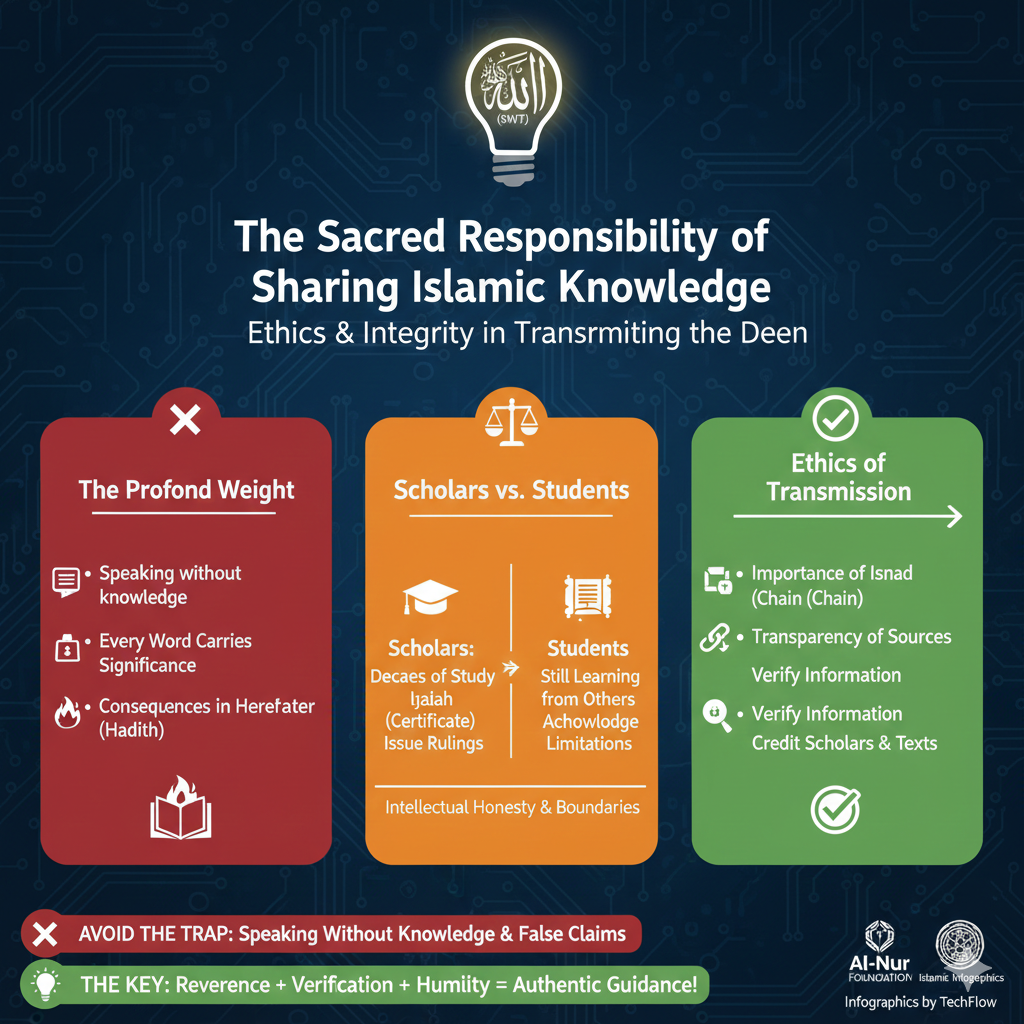
There’s a profound weight that comes with sharing Islamic knowledge. It’s not merely about conveying information or accumulating followers. When someone shares knowledge of this deen, they’re speaking about the religion revealed by Allah (SWT), preserved in the Quran, and taught by the Prophet Muhammad (peace be upon him). Every word carries significance. Every statement has consequences.
The Prophet (peace be upon him) warned us about speaking about the religion without knowledge.
He said, “Whoever speaks about the Quran without knowledge, let him take his seat in the Fire.” This isn’t meant to frighten sincere seekers from learning and sharing—it’s meant to instill the proper respect and caution that this responsibility deserves.
The Difference Between Scholars and Students: We must be honest about our limitations. There’s a vast difference between being a scholar of Islam—someone who has spent decades studying under qualified teachers, memorizing texts, understanding context, and earning the right to issue rulings—and being a student of knowledge, someone still learning, still growing, still dependent on the scholarship of those more knowledgeable.
Recognizing this distinction isn’t about false humility. It’s about intellectual honesty. When we acknowledge we’re students of knowledge rather than scholars, we’re establishing proper boundaries.
We’re saying: “What we share comes from authentic sources, from the scholars, from verified materials—not from our own understanding or opinions.”
The Ethics of Knowledge Transmission: Islamic scholarship has always emphasized the concept of isnad—the chain of transmission. Who did you learn this from? Who was their teacher? How can we verify this information? These questions aren’t academic formalities; they’re safeguards protecting the religion from distortion and innovation.
When we share Islamic knowledge today, we carry forward this tradition by being transparent about our sources. By clearly stating, “This comes from [specific scholar], in [specific text], verified by [specific methodology],” we give our readers the tools to verify for themselves and trace knowledge back to its authentic origins.
Why Sincerity (Ikhlas) Transforms Everything
In Islam, ikhlas—sincerity of intention—is the measure by which all actions are judged. Without it, even acts of worship lose their value. With it, the simplest actions can carry immense weight.
This truth applies just as deeply to seeking and sharing Islamic knowledge.
Before learning or teaching, we must ask ourselves: Why am I doing this? If the goal is to appear knowledgeable, to win debates, to gain praise, or to build influence, then the purpose of knowledge is lost. These intentions shift a sacred act into something purely worldly.
But when knowledge is sought to grow closer to Allah (SWT), to worship Him better, to understand His guidance, and to benefit others sincerely, it becomes an act of worship in itself.
Every hour of study, every lesson shared, and every reminder given gains meaning through that intention.
Earlier scholars were known to reflect deeply on their intentions before teaching or writing. They understood that sincerity is fragile and easily affected by ego.
They also knew that knowledge without sincerity can weigh heavily on a person, while knowledge paired with ikhlas becomes a source of light.
Sincerity also acts as a safeguard. It keeps a person from speaking beyond what they know, because truth matters more than recognition.
It nurtures humility because the focus remains on serving Allah, not the self. It encourages care in speech and teaching, because the aim is genuine benefit, not attention.
Ikhlas, however, is not something achieved once and forgotten. It must be renewed constantly. The heart is always tested by pride, approval, and recognition. Remaining sincere requires ongoing self-reflection and struggle—but it is this struggle that gives Islamic knowledge its true value.
Navigating the Ocean of Islamic Content Online
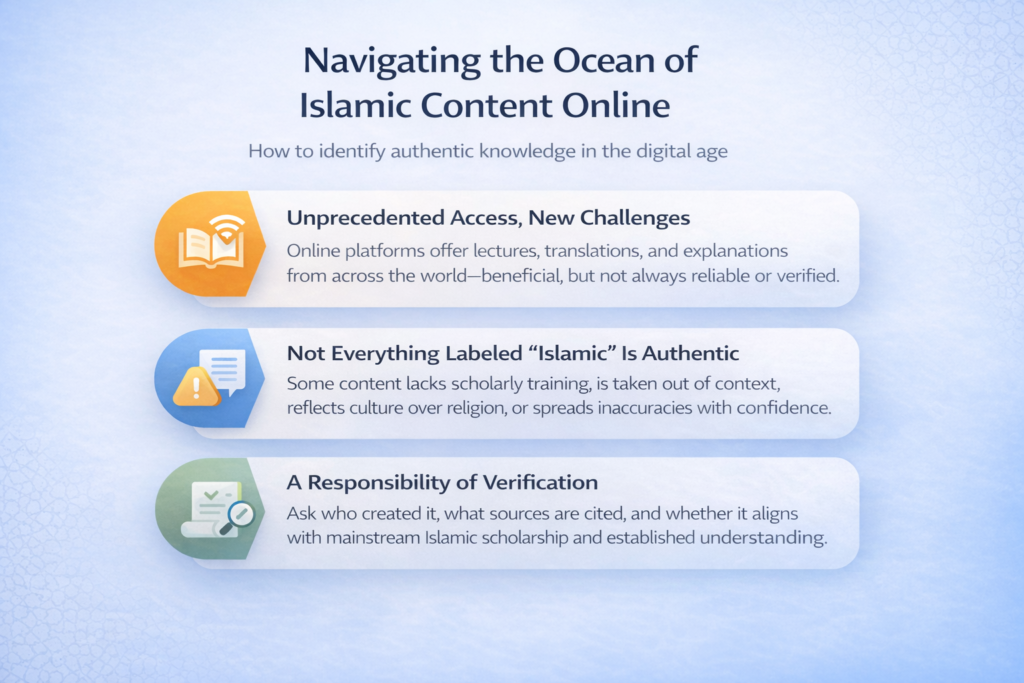
The internet has democratized access to Islamic knowledge in unprecedented ways. Lectures from scholars around the world, translations of classical texts, explanations of complex topics—all available instantly. This is genuinely remarkable and has benefited countless Muslims seeking to learn their religion.
But this accessibility comes with challenges that we must navigate wisely.
The Problem of Unverified Content: Not everything presented as “Islamic knowledge” online is authentic, accurate, or appropriate to share. Some content comes from individuals without proper training.
Some is taken out of context. Some reflect specific cultural practices presented as religious requirements. Some is simply incorrect but presented confidently.
As consumers of Islamic content, we carry the responsibility of verification. We can’t simply accept everything we see because it has an Islamic aesthetic, uses Quranic verses, or comes from someone with many followers.
Criteria for Evaluating Islamic Content: How do we distinguish authentic Islamic content from questionable material? Several questions can guide us:
- Who created this content? What are their qualifications? Did they study under recognized scholars?
- What sources do they cite? Are these sources reliable and mainstream, or fringe opinions?
- Does this align with what the mainstream scholarship teaches, or does it contradict established understanding?
- Is this presented with humility and acknowledgment of knowledge limitations, or with absolute certainty beyond the presenter’s qualification level?
- Does this content unite Muslims around established truths, or does it create unnecessary division over minor differences?
The Process of Researching Islamic Topics Properly
Creating authentic Islamic content requires more than good intentions. It requires a systematic approach to research that ensures accuracy and prevents the spread of misinformation.
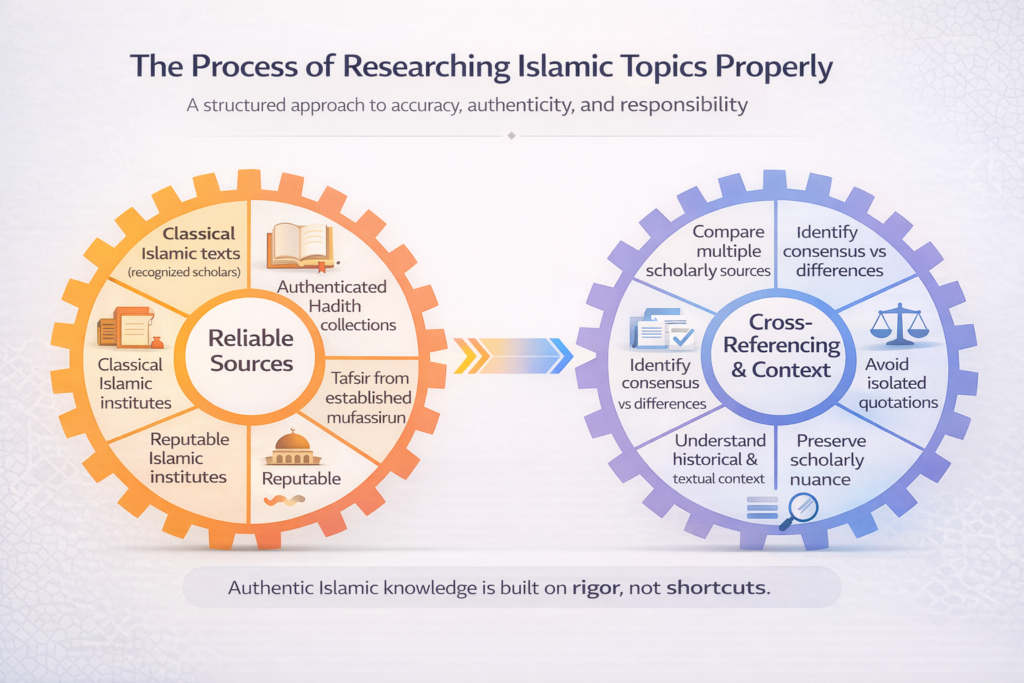
Starting with Reliable Sources: The foundation of authentic Islamic knowledge-sharing begins with sources that scholars recognize as reliable. This includes:
- Classical texts from recognized scholars of the past
- Contemporary works from qualified scholars with authentic chains of knowledge transmission
- Scholarly organizations and institutes known for academic rigor
- Verified hadith collections with proper authentication
- Tafsir (Quranic exegesis) from recognized mufassirun
Starting with these sources rather than secondary interpretations or unverified internet content establishes a firm foundation.
Cross-Referencing and Verification: One source is rarely sufficient. Responsible research involves consulting multiple reliable sources on the same topic, comparing their explanations, noting where they agree and where they might present different scholarly opinions, and understanding the broader context.
This process takes time. It can’t be rushed. A single blog post might require reviewing multiple books, listening to several lectures from qualified scholars, consulting classical texts, and verifying hadith authenticity. This investment of time is necessary—it’s part of the sacred trust of sharing knowledge about the religion.
Presenting Scholarly Differences Fairly: Within Islamic scholarship, differences of opinion exist on various issues. These differences, when based on legitimate scholarly reasoning and proper methodology, are part of the mercy of this ummah. When presenting topics where scholarly differences exist, responsible content creators:
- Acknowledge that differences exist rather than presenting one opinion as the only correct view
- Present multiple opinions fairly without bias
- Explain the reasoning behind different perspectives
- Avoid dismissing opinions held by mainstream scholars just because they differ from one’s preference
This approach respects the depth and nuance of Islamic scholarship while helping readers understand that diversity of opinion within proper boundaries is acceptable.
Building Trust Through Transparency: When Islamic knowledge platforms operate with transparency, they build authentic trust with their audience. This transparency includes clearly citing sources, acknowledging the limitations of the writers’ knowledge, being willing to correct mistakes when identified, and maintaining clear communication about the platform’s methodology and standards.
In the digital age, building this trust also requires attention to how platforms present themselves online. From having professional, clean website designs that make content accessible, to ensuring proper user experience and data handling.
Just as the content itself must be trustworthy, the platforms hosting that content should demonstrate professionalism and care in how they treat their users’ information and privacy.
The Etiquette of Learning and Sharing Islamic Knowledge
Islamic tradition places tremendous emphasis on adab—proper etiquette and conduct. This applies equally to seeking knowledge and sharing it with others.
Humility in Knowledge-Seeking: The Prophet (peace be upon him) was the most knowledgeable person, yet he constantly sought knowledge and guidance from Allah (SWT). If he demonstrated such humility, how much more should we? Recognizing that our understanding is limited, that we’re always learning, that others might understand better than us—this humility keeps us grounded and protected from arrogance.
Respecting Scholarship: While we’re all students of knowledge with access to resources, this doesn’t make us equivalent to scholars who have dedicated their lives to studying Islam. Respecting those who have earned their position through years of rigorous study means not speaking with authority we don’t possess, deferring to their understanding on complex matters, and being cautious not to contradict clear scholarly consensus based on our limited understanding.
Speaking With Certainty Only Where Appropriate: Islamic knowledge exists on a spectrum. Some matters are absolutely clear with no disagreement among scholars—these we can speak about with certainty. Other matters have nuance, multiple valid opinions, or ongoing scholarly discussion—these require presenting options rather than absolute declarations. And some matters are beyond our knowledge entirely—about these, the proper response is silence or directing inquirers to qualified scholars.
The Right to Say “I Don’t Know”: One of the most powerful statements in Islamic scholarship is “I don’t know.” When scholars throughout Islamic history didn’t know something, they said so rather than guessing or speculating. For students of knowledge, saying “I don’t know, but I can research this from reliable sources and get back to you” demonstrates more integrity than attempting to answer every question regardless of our competence.
Creating Content That Benefits the Ummah
If we’re sharing Islamic knowledge online—whether through blogs, social media, videos, or other platforms—our ultimate goal should be benefiting the Muslim community and pleasing Allah (SWT) through this service.
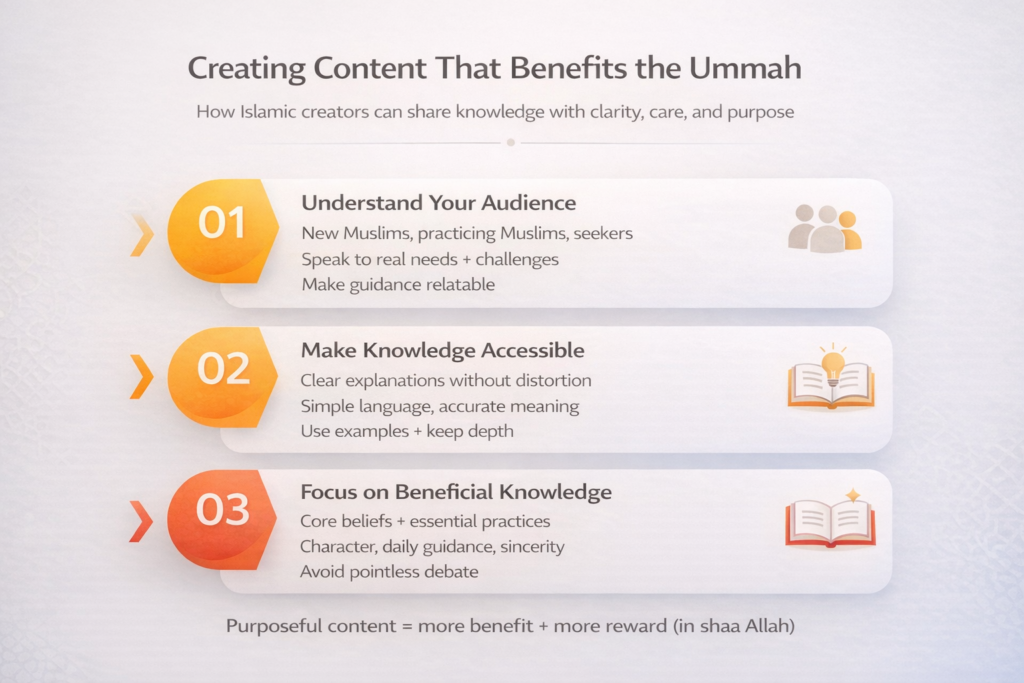
Understanding Your Audience: Effective Islamic content considers who will read or watch it. Are they new Muslims seeking basic understanding? Are they practicing Muslims wanting to deepen their knowledge? Are they dealing with specific challenges that Islamic guidance can address? Understanding the audience helps us present information in accessible, relevant ways.
Making Knowledge Accessible Without Oversimplifying: There’s a balance between making Islamic knowledge accessible to general audiences and oversimplifying complex topics to the point of distortion. Effective content finds this balance by explaining concepts clearly while maintaining accuracy, using relatable examples while preserving scholarly precision, and breaking down complex topics while acknowledging their depth.
Focusing on Beneficial Knowledge: The Prophet (peace be upon him) used to seek refuge from knowledge that doesn’t benefit. Not all Islamic topics are equally important or beneficial. Content that focuses on core beliefs, essential practices, good character, and applicable guidance serves readers better than obscure debates or hypothetical scenarios disconnected from people’s actual lives.
The Presentation of Knowledge: How we present Islamic knowledge matters as much as what we present. Content that is well-organized, clearly written, and thoughtfully formatted shows respect for both the knowledge and the reader. Whether through a carefully structured website layout, readable text formatting, or aesthetically pleasing design elements, the presentation communicates that this knowledge is valuable and worth presenting well.
The Ongoing Journey
Seeking and sharing Islamic knowledge isn’t a destination—it’s a lifelong journey. We’re always learning, always growing, always discovering new depths in what we thought we already understood. The Quran and Sunnah contain layers upon layers of wisdom that scholars spend lifetimes exploring.
As students of knowledge, our role is to keep learning, keep researching, keep improving in our understanding, while sharing what we’ve verified from reliable sources. It’s to maintain sincerity in our intentions, authenticity in our content, and respect for the tradition we’re representing.
Every piece of Islamic content we create, every article we write, every social media post we share carries weight. It might be someone’s introduction to an Islamic concept. It might clarify a misconception. It might inspire someone to learn more, to practice better, to draw closer to Allah (SWT).
That responsibility is immense. But when approached with the right intention, proper methodology, and humble recognition of our limitations, it becomes one of the most noble acts we can engage in—participating in the preservation and transmission of Islamic knowledge for generations to come.
May Allah (SWT) grant us sincerity in our intentions, authenticity in our work, accuracy in our research, and benefit in what we share. May He protect us from speaking about the religion without knowledge, from arrogance in what little we know, and from any content that misleads rather than guides.
Ameen.
Conclusion
Some nights, after scrolling past a dozen beautifully designed quotes and “Islamic reminders,” I catch myself thinking about how strange our times really are. Never before has knowledge been so close to our fingertips — and yet never has confusion felt so common. A single post can reach thousands in seconds. A single mistake can travel just as fast.
That reality should slow us down.
Because sharing Islamic knowledge isn’t like sharing a recipe or a productivity tip. It’s speaking about Allah. About His Messenger ﷺ. About a deen that shapes how people pray, marry, raise children, and prepare for the Hereafter. That’s not light work. It’s sacred work.
So maybe the goal isn’t to be the loudest voice online or the fastest to post the next “reminder.” Maybe it’s quieter than that. Maybe it’s choosing accuracy over speed. Depth over virality. Sincerity over applause.
Maybe it’s pausing before we hit “share” and asking:
Do I really know this is true?
Have I verified it?
Is this benefiting people — or just feeding my ego?
If we can hold onto that mindset, everything changes.
We become students before teachers. Careful before confident. Humble before authoritative. We learn to say “I don’t know” without embarrassment. We trace our knowledge back to scholars. We treat sources like a trust, not an afterthought. And most importantly, we renew our intentions — again and again — so that our efforts are for Allah alone, not for followers or praise.
In the end, we may never become scholars. Most of us won’t. But we can still be responsible carriers of knowledge. We can be bridges that connect people to authentic scholarship rather than barriers that spread confusion.
And sometimes, that’s enough.
Because one verified reminder, shared sincerely, can guide a heart.
And guiding even one heart is worth more than a thousand viral posts.
May Allah make us careful with our words, honest about our limits, sincere in our intentions, and a source of benefit — never harm — to this ummah.
Ameen.


