
Imagine this: You stand before Allah on the Day of Judgment, hopeful that your lifetime of prayers will be your salvation. But you are shown that your Salah, the most important pillar of your faith, was consistently flawed and displeasing to Allah, all because of a single, overlooked mistake.
This terrifying scenario is not a distant possibility; it is a daily reality for countless Muslims who, often out of ignorance, neglect one of the fundamental conditions of a valid and accepted prayer: the proper Islamic attire.
This article is an urgent and heartfelt reminder. We will take a deep dive into what the Quran and Sunnah say about the dress code for prayer (Salah), debunk dangerous misconceptions, and provide a clear, practical path to ensure our most precious act of worship is not being wasted.
The Widespread Problem: A Crisis of Modesty in Our Mosques
Walk into many mosques today, and you will see a troubling trend, especially among the youth: men praying in tight, form-fitting jeans and short, graphic t-shirts. This modern attire, while common in daily life, presents critical problems in the sacred act of Salah.
-
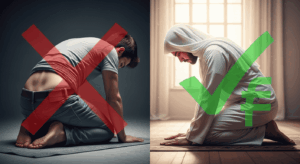
Exposing the ‘Awrah (Parts to be Covered): The most severe issue is the exposure of the ‘awrah. For a man, the ‘awrah is the area from the navel to the knees. When a person wearing a short t-shirt goes into Ruku (bowing) or Sujood (prostration), their shirt often rides up, exposing a part of their lower back. According to the consensus of scholars, if any part of the ‘awrah is uncovered during prayer, the prayer is rendered invalid (batil). You are, in effect, not praying at all.
-
Revealing the Body’s Shape: Islam is a religion of modesty (Haya). Tight-fitting clothes, even if they cover the skin, defeat the purpose of concealment by revealing the precise shape of the body’s private parts. This contradicts the spirit of modesty that Salah is meant to instill.
-
Disturbing Others: Your attire doesn’t just affect you. The person standing behind you in prayer is trying to concentrate on their connection with Allah. When your back becomes exposed, it becomes a source of distraction and fitnah for them, disrupting their worship. You not only risk your own Salah but also bear the sin of disturbing another’s.
Debunking a Dangerous Misconception: “But the Prayer is Valid, Right?”
A common defense is, “My Salah is still valid. A scholar told me it’s okay.” This is a grave misunderstanding based on a partial truth.
Yes, in a situation of extreme and unavoidable necessity—for instance, a person has no other clothes and the prayer time is expiring—scholars permit praying in such attire to fulfill the obligation. This is a license for an emergency, not a permission for a lifestyle.
To take this emergency ruling and apply it to our daily lives, where we have closets full of clothes, is a deception from Shaytan. A prayer offered in clothing that is displeasing to Allah is classified as Makruh (detested). And we must ask ourselves: why would we knowingly offer our most important act of worship in a state that is detested by the One we are worshipping?
What the Quran and Sunnah Say About Clothing
The standard for our attire is not set by culture or fashion, but by divine revelation.
1. The Purpose of Clothing in the Quran:
Allah (SWT) clearly defines the purpose of clothing:
“O children of Adam, We have bestowed upon you clothing to conceal your private parts and as adornment. But the clothing of righteousness (libas-ut-taqwa) – that is best.” (Quran, Surah Al-A’raf, 7:26)
This verse highlights two primary goals: concealing what must be concealed, and serving as a means of dignity and beauty. The best clothing of all is that which reflects our consciousness of Allah.
2. The Prohibition of Arrogance:
The spirit of Islamic clothing is humility, not pride. The Prophet (ﷺ) warned:
“Whoever wears a garment of pride and vanity in this world, Allah will clothe him in a garment of humiliation on the Day of Resurrection, then set it ablaze.” (Sunan Ibn Majah)
Loud, branded, or body-baring clothes worn to show off one’s physique fall under this warning. The mosque is a house of humility, not a fashion show or a gym.
3. The Importance of Covering the Shoulders:
The Prophet (ﷺ) was very specific about prayer attire, even for men.
Abu Huraira reported: The Messenger of Allah (ﷺ) said, “None of you should pray in a single garment with no part of it over his shoulders.” (Sahih al-Bukhari, Sahih Muslim)
This Hadith makes it clear that just covering the ‘awrah is the bare minimum. Proper decorum in front of Allah requires more. Praying in a sleeveless shirt or tank top, even if it covers the navel, goes against this prophetic guidance.
4. The Command to Adorn Oneself for Prayer:
Allah commands us to treat our meeting with Him as a special occasion:
“O Children of Adam, take your adornment (zeenah) at every masjid…” (Quran, Surah Al-A’raf, 7:31)
“Zeenah” means to wear clean, appropriate, and respectable clothing. Ask yourself: would you meet a king, a CEO, or attend a wedding in a tight, revealing t-shirt? Then how can we stand before the King of all Kings in such a manner?
5. The Warning Against Imitation:
While jeans and t-shirts are not inherently haram, we must be mindful of the cultures and lifestyles they often represent. The Prophet (ﷺ) said:
“Whoever imitates a people is one of them.” (Sunan Abi Dawood)
We should be proud of our Islamic identity and choose clothing that reflects our values of modesty and humility, not the values of a culture that often promotes the opposite.
The Simple and Practical Solution: The “Salah Outfit”
The solution is incredibly simple and requires minimal effort.
-
Dedicate a Prayer Garment: Keep a clean, loose-fitting garment specifically for prayer. This could be a simple thobe, a long kurta, or even a loose-fitting tracksuit. Keep one at home, one in your car, and one at your workplace. It takes less than 30 seconds to slip it on over your regular clothes.
-
Ensure Proper Coverage: Your prayer clothes should be loose enough not to reveal your body’s shape and long enough to ensure your back is never exposed, even in Sujood. The sleeves should cover at least the elbows, and ideally, the wrists.
-
Choose Simplicity: The best prayer clothes are simple and clean, preferably white, as it was a color beloved by the Prophet (ﷺ). Avoid distracting images, large logos, or loud text.
Conclusion: Don’t Just Perform Salah, Establish It
The Quran consistently uses the term “Establish Salah” (aqeem-us-salah), not just “perform Salah.” To establish something is to build it perfectly, with all its pillars, conditions, and etiquettes fulfilled. This includes our internal state of concentration (khushu) and our external state of purity and respectful attire.
Salah is the coolness of the eyes of our Prophet (ﷺ). It is the first matter we will be questioned about on the Day of Judgment. Let us not allow laziness or a lack of concern to devalue this priceless gift.
Let us make a sincere intention today to honor our prayer by honoring our appearance before Allah. Let us ensure that our Salah is not just an empty ritual, but a beautiful, valid, and beloved conversation with our Lord.
Subscribe EG Islam

Earn Money Please Download Pocket Money App

Read More Most Poplar Our Blogs and Dua
7 Reasons Why Your Dua Isn’t Answered (And How to Fix It)
Before the Universe: The Islamic Story of Creation and the Light of Prophet Muhammad
Qiyamah,The Day of Judgment: A Complete Islamic Guide to the End of Times
Tahajjud Prayer: A Complete Guide to the Night Prayer That Can Change Your Life
Al-Alamin: Unlocking the Quran’s Secret of the Worlds Through Science
A Powerful Quranic Dua for Jaundice (Piliya): Healing from Surah Al-Hashr
Islam’s Answer to Depression & Anxiety: A Guide to Healing Your Heart
The Quran’s Promise: How Taqwa, Istighfar, and Gratitude Can Increase Your Wealth and Rizq
A Muslim’s Guide to Social Media: Halal vs. Haram
Dreams in Islam: A Complete Guide to Good Dreams vs. Bad Dreams
The World of Jinn: An Islamic Guide to the Unseen (Fact vs. Fiction)
Thanks For All


